Tuesday, November 13, 2018

FDR and The New Deal

Short biography:
Image result for fdr biography       Franklin D. Roosevelt (FDR) was elected president in 1932, 1936, 1940, and 1944 as the 32nd president. In his early life, he grew up in Groton, Massachusetts and entered Harvard for college. He fell in love with Eleanor Roosevelt (a distant cousin) and the two were married. At 39, Roosevelt caught polio and lost use of his legs. During his presidency, Franklin Roosevelt was most known for The New Deal.

The New Deal:
Image result for the new deal       Before he was elected, Roosevelt caught the attention and support of many because of his statement that he would help "the forgotten man at the bottom of the economic pyramid" in which later he kept the promise by "a new deal for the American people." The New Deal was a set of domestic policies that expanded the federal government's role in helping the Great Depression. It is often described by the 3 R's: Relief for the unemployed, Recovery of the economy, and Reform of capitalism.

The First New Deal:
      Also known as "The First Hundred Days," the First New Deal passed legislation addressing bank crisis, unemployment, and weak industrial performance. Several of the most important were: The Agricultural Adjustment Act (AAA), The Civilian Conservation Corps (CCC), The Federal Emergency Relief Act (FERA), The National Recovery Act (NRA), The Federal Deposit Insurance Corporation (FDIC), and the Securities and Exchange Commission (SEC).

The Second New Deal:

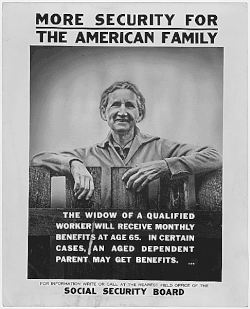
       This deal worked to increase worker protection and build strong financial security. The most important were: The Works Progress Administration (WPA), The Wagners Labor Relations Act, The Social Security Act, and The Fair Labor Standards Act.

The New Deal was actually only partially successful in relieving the Great Depression. However, many aspects of the New Deal still exist today, helping our economy stay strong such as regulation of wages, child labor, working hours, collective bargaining, and the social security system.

Monday, November 12, 2018

Model T

The Ford Model T was first produced from October 1, 1908, until May 26, 1927. It is widely thought of as the first affordable car and is known for its unparalleled availability to middle-class American. Additionally, its popularity was magnified by its ability to be driven anytime, its ability to transport one's family, its range, its large-scale production, and its ability to symbolize individuality and innovation.

Related image
1908 Model T

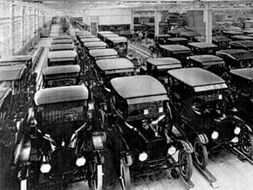
Its irregularly low price was mainly due to the efficiency of its production, as it was one of the first cars to ever be mass-produced on an assembly line. Whereas other cars at the time were being individually handcrafted out of wood and were, therefore, could only be purchased by members of the upper class. However, the use of a complete assembly line was not implemented until 1910, after the production of 12,000 Model T's. These first 12,000 cars were built with increasingly large amounts of machinery, which greatly increased the production rate and greatly lowered the cost. This eventually led to the modern assembly line, while in the first month of production, only 11 cars were completely built.

Image result for model t assembly line   Image result for model t assembly line
Early Assembly Lines 

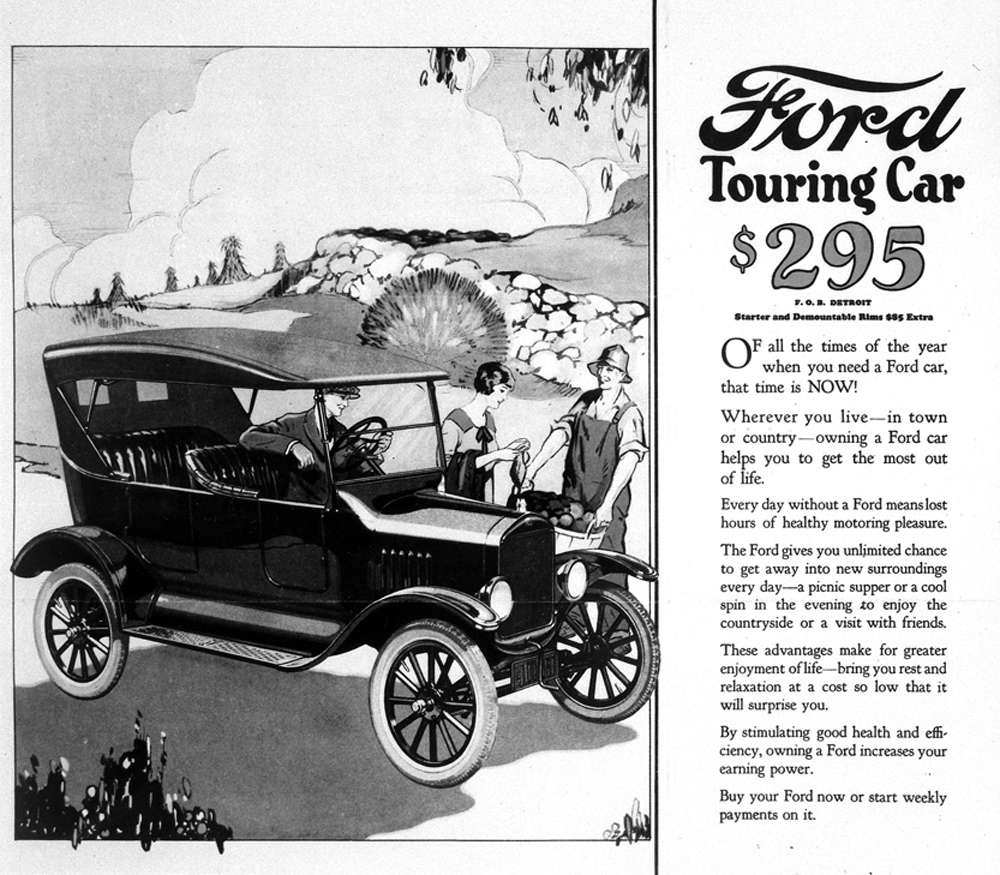
This heightening production rate was mainly forced to increase because of the car's high demand. Ford's advertising strategies appealed to the expanding middle class, as the economy was still growing at the time. Before the initial release of the car, Ford said, "I will build a car for the great multitude. It will be large enough for the family, but small enough for the individual to run and care for. It will be constructed of the best materials, by the best men to be hired, after the simplest designs that modern engineering can devise. But it will be so low in price that no man making a good salary will be unable to own one." These attractive claims encouraged over 15,000 people to order a Model T within the first days of its release. This demand increased exponentially and in 1918, half of all the cars in the U.S. were Model T's. As of 2012, the Model T is the eighth most sold car of all time, at 16.5 million.

Image result for henry ford model t advertisementImage result for henry ford model t advertisement
Various "Model T" Advertisements

The Model T had a 20 hp engine and a top speed of 40–45 mph and a range of 13–21 mpg. Famously, in 1909,  Ford said that, "Any customer can have a car painted any color that he wants so long as it is black." Despite this claim, the Model T was made in gray, green, blue, and red until 1913, and only in 1914 was the car only available in black. During its reign spanning almost two decades, there were numerous versions of the Model T.

All Versions of the "Model T" 

Sunday, November 11, 2018

flappers and vamps

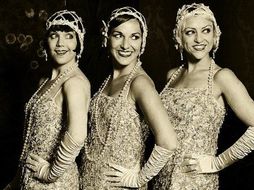
Flappers and vamps where the more daring women of the 1920's. They were women who typically wore short skirts or dresses with their hair and makeup done. The Flappers and Vamps here the type of women to see how far they could go and get and then they would stop. They were key in the 1920's because they changed the way women were seen and the way they dressed. Also, they often drank and smoked in public. They also helped to the expansion of Jazz in America. In America, there was a controversy on how people felt about flappers. Some people saw it as an eyeopening experience for young women because they saw how women were going to change and how much more they could do. Others, on the other hand, saw it as women violating their own codes and exposing themselves too much to get something.  This is what the flappers looked like.
Image result for flappers

Saturday, November 10, 2018

Great Depression VS Great Recession Infographic


The Average Family Life During the Great Depression

4 years after the market crash,  about 25% of the workforce was still unemployed. Those lucky enough to keep their jobs saw their wages cut, or their work hours reduced to part-time. Even upper-class professionals like doctors and lawyers had income drops of up to 40%. 

Image result for families in the great depression

Families that were enjoying life with economic stability and security were now financially unstable, or even worse. 

A common motto during these times was "Use it up, wear it out, make do or do without." Lots of families struggled to keep up appearances and carry on while they adapted to new economic conditions. Families started patching up worn out clothes and stopped going out to the movies as they were working hard to not lose their cars or homes. 

Radio shows and magazines now discussed topics like stretching food budgets with casseroles and one-pot meals. Some of these were dishes like macaroni and cheese, chili, and soup. Many families also had "kitchen gardens", where they tried to be self-sufficient and grow small amounts of food on their own. "Thrift gardens" provided food for thousands and thousands of people, where you could often see office workers who had lost their jobs working in the field, still wearing their work clothes. 

Image result for families in the great depression

People stopped going to expensive places, and theaters began shutting down, while board games and family activities became very widespread. Monopoly and Scrabble were among these. However, some families couldn't even survive and many families split up and broke down. Marriage rates lowered and abandonment increased.

Bank Failures

Because of the Dust Bowl, farmers defaulting on their loans was one of the main factors for banks failing in the Great Depression.

In the stock market crash in 1929, "hundreds of thousands" of customers began hurriedly withdrawing their deposits overnight. As the banks had no money to loan, and recipients of their loans couldn't pay them back, the banking crisis only got worse.

Image result for great depression banks

Much later, in 1933, Roosevelt took office and soon declared a three-day "National Bank Holiday" to stop people from withdrawing from banks, as a sort of cooling-off period. When the banks were allowed to open again, the cooling off had amazingly saved 1,000 banks. To help get this process going, he said: "The only thing we have to fear is fear itself."


                                                                                            Image result for bank holiday 1933

On January 1st, 1934, the Federal Deposit Insurance Corporation (FDIC) was established in order to give depositors real security over their money. Since then, nobody has ever lost their money in the bank that they had insured.

At the end of it all, bank failures had cost Americans 140,000,000,000 dollars, as their hard-earned money was gone.

Friday, November 9, 2018

Hoovervilles

Constructed in the midst of the Great Depression, Hoovervilles were makeshift towns filled with the unemployed and the poor. Named after the unliked president at the time, Hoover, the American people were forced to abandon their pride and settle in the makeshift, shabby homes that mirrored the American economy. These "homes" were constructed of aluminum roofs and cardboard walls, much like that of the homeless people may see on the streets in large cities. Except during the Great Depression, virtually everyone was suffering; losing their jobs and going broke, forced to sell everything of value to them. These Hoovervilles were constructed with exactly in mind: living on the bare minimum that their government had failed to protect them from. These Hoovervilles were a sign of distress and anger in a time when there was little hope for change and even a lesser amount of resources.

Killing Osama

After being elected President, Obama accomplished many things but the most notable is ordering the killing of Osama Bin Laden. After several...