Sunday, December 9, 2018
The Double V Campaign
Since the beginning, African Americans have been fighting in wars alongside other Americans and they always hoped it would have earned them liberty and recognition under the law as equals. A popular publication representing these African Americans called the Pittsburgh Courier worked with the African Americans looking for recognition. Once the U.S. got involved into World War II the Pittsburgh Courier was highlighting the fact that Hitler's words sounded very familiar to the African American ear. The publication came out with the slogan "Victory at Home & Victory Abroad," meaning that if African Americans are willing to fight and die for their country, then they should be recognized as equally part of the country. African Americans constantly argued, especially those going off to fight in World War II, that the country is constantly fighting to protect freedom and democracy in other countries and never worry about the freedom and democracy within their own country. These African Americans helping in the war were the key to pointing out the hypocrisy within the nation, and gave them a good way to advance in the struggle to end segregation.

Operation Bodyguard
As Germany was gaining power throughout all of Europe, the allied leaders decided they would invade Nazi Germany through the beaches of Normandy. It took them almost an entire year to make a plan, and they even created a big misinformation campaign codenamed Operation Bodyguard to essentially make the Nazi's think the invasion would be anywhere except on Normandy's beaches. A lot of the success of this campaign came from the German spies that were in Britain and turned into double agents. Through these double agents, the allies were able to misinform Hitler on a lot of information. One of the most famous ways the Allies were able to deceive the Nazi's was by faking a massive troop buildup in an area away from the actual landing spot. They broadcasted fake radio transmissions and even tricked the German planes by having many balloon tanks to make it seem as if there was a buildup of troops. During this time, they even hired an actor who resembled General Bernard Montgomery to further convince the Germans. Even while the Normandy invasion began, Juan Pujol Garcia a double agent working for Britain kept sending notes to Berlin that it was simply a distraction and that a major attack was yet to come. This gave the Allies the advantage they needed to be able to turn the tide of World War II and begin to liberate the countries in Europe.
Photography and Film in WWII
During World War II, photographers who were not drafted, alongside the rest of the American society, pledged their support towards the war effort, in favor of democracy and the prosperity of the United States. War documentation was also popularized by the developing trend of social documentary photography, which had started during the Great Depression. The service of documenting soldiers in the war was mainly meant to support and advertise the nation's democratic ideals and values. During World War II, the photography of Americans affirmed the widespread, shining image of the United States as the land of the free.
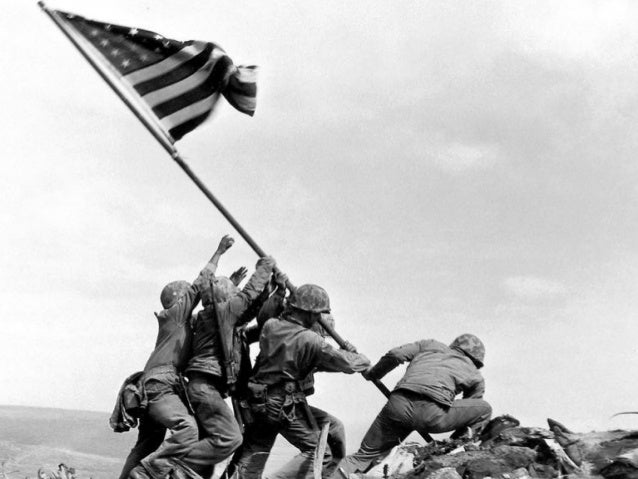 To protect this image, the Government placed a large amount of censorship on the media. General Dwight Eisenhower wrote, "[Photographers] have a job in war as essential as the military personnel… fundamentally, public opinion wins wars." Censors banned photographs of dead American boys, images that "portrayed the American military in an unfavorable light," and even. at times, photographs of African-American participation in the military. These strict rules were nonnegotiable, forcing the press to not only agree to the restrictions for the news but also distribute handouts and military photographs. This served as a platform for the Government to directly deliver war propaganda to its citizens. However, almost two years into the war, President Franklin Roosevelt and the War Department reversed the regulations due to the high business-labor tensions and opposition to higher taxation. Roosevelt thought that the country needed to see the casualties in order to understand what was really at stake. The new guidelines began in September 1943, allowing photographs of American soldiers bleeding, dying, and dead to finally be revealed. These images formed a public realization of the reality of war.
 Furthermore, the intercontinental nature of World War II presented a set of challenges to photographers including expense, transportation, and communication. Fortunately, the technology developed in WWI such as Long-range airplanes and more compact cameras made delivery and processing of film and prints more reliable. Despite these advancements, photographers still worked to document all the fronts and provide content to all publications.

 65 military photographers, cameramen, and darkroom technicians accompanied U.S. troops at the beginning of their operations abroad, but it wasn't until the Normandy D-Day invasion when the number of combat photographers reached 100. During the entire war, military combat photographers produced over half of a million pictures to The U.S. and British media. Overall, it is confirmed that at least 37 photographers were killed, 112 were wounded in action, 8 were torpedoed, 50 were imprisoned, and 67 contracted malaria. Their bravery and sacrifice are indisputable.

Role of Minority Groups in WWII
Marginalized groups of people played a significant role in the American war effort. Despite being deprived of their civil rights, Japanese-Americans enlisted in the army to prove their American allegiance. The US army recruited men of the Navajo nation to work as "code talkers". Additionally, Africans Americans served in the army of a country that systemically robbed them of their human rights. These groups of people fought for the future of America, not knowing whether their safe future would be secured as well. Their efforts should not go unnoticed.
Some members of these ethnic groups were not as willing to serve the country. The "No-No-Boys" were a group of Japanese Americans who refused to serve in the army after Japanese people were forced into internment camps by the American government. They did not want to show loyalty to a country that dehumanized their people and refused them of their right to due process and considered them "alien" despite their citizenship status.
hedgerow country

General McAuliffe
General Anthony Clement "nuts" McAuliffe was a senior United States Army officer who earned fame as the acting commander of the U.S. 101st Airborne division troops defending Bastogne, Belgium, during the battle of the Bulge in the World War 2. General McAuliffe was born in July 2, 1898 and passed away in August 11, 1975. He went to the United States Military Academy from 1917-1918, West Virginia College from 1916-1917, and US Army War College in 1940. He received the Distinguished service Cross and Legion of Merit awards. After the battle of the Bulge he was promoted and given command of the 103rd Infantry Division, which he lead from January to July of 1945. In 1956 he had retired from the army and worked for American Cyanamid Corporation from 1956 to 1963 as vice president for personnel. He began a program to teach employees to maintain contact with local politicians. He also served as chairman of the New York State civil defense commission from 1960 to 1963.

Dieppe Raid
The Dieppe Raid was an allied assault on the German-occupied port of Dieppe, France on the 19 of August of 1942 during the time of World War 2. The main assault lasted less than 6 hours until strong German defenses and mounting Allied losses forced its commanders to call a retreat. Over 6,000 infantrymen, predominantly Canadian, were supported by The Calgary Regiment. It involved 5,000 Canadians, 1,000 British troops, and 50 United states Army Rangers. The objectives were to seize and hold a major port for a short period. Upon retreat the allies also wanted to destroy coastal defense, port structures, and strategical buildings. All of the objectives failed, Allied fire support was grossly inadequate and the raiding force was trapped. Of the 6,086 men who made it ashore, 3,623 were either killed, wounded, or captured.

Subscribe to:
Posts (Atom)
-
The Flappers and Vamps were a generation of young women from the West, who completely challenged the idea of how women should act during in...
-
After World War I, many Americans believed that immigrants took away jobs and increased the unemployment rate. With the increasing fear of r...
-
The Swastika, 卐, is a symbol that originated in Eurasia, that was meant to serve as a universal image for spirituality. It was also commonly...

